

Key Takeaways:
Master these 15 proven strategies to attract more customers, strengthen retention and grow your lawn care or landscaping business with integrated marketing and automation.
- Lawn care marketing is the combination of digital and offline strategies — local SEO, email automation, direct mail and referral programs — that attract customers and grow revenue.
- Local SEO and Google Business Profile are the highest-ROI free marketing tools available to lawn care companies. 97% of consumers check reviews before choosing a local service, according to BrightLocal's 2024 Local Consumer Review Survey.
- RealGreen's Automated Marketing Assistant sends more than 50 personalized customer touchpoints automatically — including pre-service notifications, estimate follow-ups and year-end renewal campaigns.
- Email marketing delivers $36 to $40 in return for every $1 spent, according to Litmus's 2024 Email Marketing ROI Report — the highest ROI of any marketing channel.
- Over 400,000 people move in the U.S. every week (U.S. Census Bureau, 2024). RealGreen's Direct Mail and List Data Services help businesses reach new homeowners before competitors do.
- ServiceBot closes sales 24 hours a day, seven days a week across 25 service categories — capturing leads at the moment prospects are ready to buy.
- Lawn Plus grew from $500,000 to $5 million in revenue over a decade by fully leveraging RealGreen's platform — proof that consistent marketing investment produces compounding growth.
Ready to streamline your marketing efforts and accelerate growth? Schedule a demo with RealGreen to discover how our integrated CRM, Automated Marketing Assistant and customer communication tools help lawn care businesses manage more customers effortlessly.
What Is Lawn Care Marketing?
Lawn care marketing is the combination of digital and offline strategies that lawn care and landscaping businesses use to attract new customers, retain existing ones and grow revenue. It includes local SEO, email automation, direct mail, social media, referral programs and integrated customer communication tools that work together as a system — not as separate, disconnected efforts.
The green industry represents more than $153 billion in annual economic activity across more than 661,000 businesses in the U.S., according to the Professional Landcare Network's 2024 industry report. Demand is strong, but demand alone does not fill a route. The businesses growing fastest are the ones most consistently communicating their value across multiple channels while their software handles the follow-up automatically.
"I believe the cost of staying the same is greater than the cost of change." — James Szojka, Owner, Yard Dawgs
RealGreen customers collectively processed more than $3.5 billion in transactions last year. That outcome is the product of great field work paired with integrated marketing systems that keep customers engaged, generate referrals and convert leads without manual effort from your team.
Why Does a Lawn Care Business Need a Marketing Strategy?
A lawn care business needs a marketing strategy because word-of-mouth and yard signs alone cannot sustain growth in a competitive local market. A documented strategy ensures every dollar and hour spent on marketing works toward a measurable outcome — new customers acquired, existing customers retained and revenue per customer increased.
Marketing is how your business communicates the quality and reliability of your work before a prospect ever calls. It builds the recognition that makes a neighbor refer you, the trust that makes a prospect choose you over a cheaper competitor and the retention systems that keep customers renewing year after year without you chasing them.
"We can be so much more productive and work ON the business instead of IN the business and just managing the hurricane of paper." — Matthew Daniels, Owner, Bio-Spray
Strategy 1: What Makes a High-Converting Lawn Care Business Website?
A high-converting lawn care website clearly lists services and pricing, includes an easy online quote or booking form, displays before-and-after project photos and shows customer reviews prominently. Mobile optimization is essential — more than 52% of web traffic comes from mobile devices, according to Statcounter's 2025 Global Stats report, and Google penalizes sites that load slowly on mobile.
Every page should give visitors a low-friction path to take action. Key elements include: your services listed with clear descriptions, a prominent phone number and online booking option, before-and-after project photos with captions, customer testimonials and links to your Google and Yelp review profiles, and a newsletter signup form for email list building. Page speed directly affects both user experience and search ranking — Google's Core Web Vitals data shows that pages loading in under two seconds see 15% lower bounce rates. For design inspiration, see our roundup of the 10 best lawn care website designs to see what high-converting service sites look like.
RealGreen's Customer Assistant Website (CAW) turns your website into a 24/7 self-service portal where customers can book services, pay invoices, sign up for auto-pay and manage their own accounts without any staff involvement. RealGreen customers with CAW have 12% more customers on auto-pay than those without (RealGreen Product Data, 2024) — increasing predictable, recurring revenue.
"It is very important to create a headache-free, frictionless customer service experience. RealGreen enables us to do that. We can answer any question they have — we have the history and the data — and we can service them with the professionalism and speed they are looking for. When you can do that, you can charge premium prices." — James Szojka, Owner, Yard Dawgs
Ready to turn your website into a 24/7 sales portal? Schedule a free RealGreen demo to see Customer Assistant Website in action.
Strategy 2: How Does SEO Help Lawn Care Businesses Get Found Online?
SEO — search engine optimization — is the process of improving a lawn care website's visibility in Google search results for queries like "lawn care near me" or "landscaping company in [your city]." On-page SEO involves incorporating target keywords into page titles, H1 and H2 headings, image alt text and body content. Off-page SEO involves earning backlinks from local directories, industry publications and partner businesses that signal authority to Google.
Local SEO delivers the highest return for lawn care companies. Use location-specific keywords throughout your content — phrases like "lawn fertilization Columbus OH" or "landscaping company Nashville" — build citations in directories like Yelp and Angi and ensure your NAP (Name, Address, Phone number) is identical across every listing. Google Search Console, a free tool, shows which keywords currently drive impressions and clicks to your site, revealing the highest-opportunity terms to optimize further. For a full walkthrough, read our complete guide to lawn care SEO.
RealGreen's Measurement Assistant generates accurate property measurements using ALK aerial photography. Use that property data — common lot sizes, turf types and service pricing in your service area — to create location-specific content that improves both local SEO relevance and estimate accuracy.
Strategy 3: Why Does a Google Business Profile Matter for Lawn Care Companies?
A Google Business Profile (formerly Google My Business) is a free listing that places your lawn care company in Google Maps results and the local search panel. 97% of consumers check online reviews before choosing a local business, according to BrightLocal's 2024 Local Consumer Review Survey — making your profile one of the highest-impact free marketing tools available.
A fully optimized Google Business Profile includes: your verified business name, primary and secondary categories (use "Lawn Care Service" and "Landscaping Company"), accurate service area, phone number, website URL, business hours and holiday hours. Businesses with photos receive 42% more direction requests and 35% more website clicks than those without, according to Google's own platform data. Every review — positive or negative — should receive a professional response within 48 hours.
RealGreen's ServiceBot includes ReviewBot — an automated tool that prompts satisfied customers to leave five-star reviews at the optimal moment after service completion. A steady flow of recent positive reviews improves local search ranking and builds the trust that converts prospects into customers.
Strategy 4: How Do Pay-Per-Click Ads Generate Leads for Lawn Care Businesses?
Pay-per-click (PPC) advertising places your lawn care business at the top of Google search results when prospects are actively searching for services — and unlike SEO, which builds over months, PPC generates leads immediately. The average small lawn care company spends $500 to $2,000 per month on Google Ads and achieves a cost per lead of $25 to $75, depending on market competition.
Google Search Ads target high-intent keywords — phrases like "lawn fertilization near me" or "landscaping estimate [city]" — where the prospect is actively looking to hire. Each ad should link to a dedicated landing page matching the specific service advertised, not your homepage. Landing pages with a single, clear call-to-action convert at two to three times the rate of generic homepages, according to HubSpot's 2024 Marketing Benchmarks Report. A/B testing ad copy — running two headline variations simultaneously — improves click-through rates by an average of 30% over time. For a broader set of acquisition tactics beyond PPC, see our guide to 17 lawn care lead generation strategies.
RealGreen's ServiceBot is an AI-enabled chatbot that closes sales 24 hours a day, seven days a week, 365 days a year. ServiceBot guides prospects through quoting, handles common objections, collects payment and schedules service — without any staff involvement. It supports 25 service categories and feeds every lead directly into Service Assistant CRM automatically.
See how ServiceBot captures leads around the clock — book a free RealGreen demo to watch it in action.
Strategy 5: Which Social Media Platforms Work Best for Lawn Care Marketing?
Facebook and Instagram are the most effective social media platforms for lawn care businesses. Facebook's audience skews toward homeowners aged 35 to 65 — the core lawn care customer demographic — and offers the most sophisticated local geographic ad targeting available. A $10 to $20 per day ad budget targeting homeowners within a 15-mile radius generates meaningful lead volume in most markets.
Instagram's visual format is ideal for before-and-after transformation content that builds brand credibility at scale. Nextdoor is underutilized by most lawn care competitors but highly effective for neighborhood-level referrals — Nextdoor's 2024 platform data shows that neighbor-to-neighbor recommendations are trusted by 88% of users. Post consistently — at minimum three times per week — with a mix of before-and-after photos, seasonal tips and crew spotlights. Visual content on social media is 40 times more likely to be shared than text-only posts, according to HubSpot's Social Media Report (2024).
RealGreen's Mobile Live app lets technicians capture property condition photos, complete work orders and sync production data from any mobile device — giving your marketing team a consistent stream of authentic before-and-after content without adding any administrative burden to the back office.
Strategy 6: What Email Marketing Strategies Work Best for Lawn Care Businesses?
Email marketing delivers $36 to $40 in return for every $1 spent, making it the highest-ROI marketing channel available to service businesses, according to Litmus's 2024 Email Marketing ROI Report. For lawn care companies with recurring customers, email is especially powerful — the same households need service month after month and season after season.
Build your email list through your website signup form, at the end of every estimate and during in-person service interactions. Segment your list by service type — lawn care, pest control, irrigation, holiday lighting — so every communication is relevant. Personalized subject lines generate 50% higher open rates than generic ones, according to Campaign Monitor's 2024 Email Benchmark Report. High-impact email types: a welcome series for new customers (welcome emails average a 68.6% open rate per GetResponse, 2024), seasonal service reminders, renewal prompts sent 30 to 45 days before plan expiry, upsell campaigns and post-service review requests sent within 24 hours of completed work. For a deeper look at sequencing and segmentation, read our guide to mastering landscaping email marketing.
Strategy 7: How Does Marketing Automation Help Lawn Care Businesses Scale?
Marketing automation for lawn care businesses is the use of software to send personalized customer communications automatically — triggered by service dates, payment status, customer behavior and seasonal timing — without manual effort from your team. Automation is the difference between marketing that runs consistently and marketing that depends on someone finding the time.
"You're never going to be able to grow and provide a high level of customer service and engagement along the way without software. You need to be able to touch those customers multiple times — before the service, after the service and throughout the year. If you have a business with 1,000 or more customers, and you're trying to touch them 10 times a year, I don't know how you do that manually. It's impossible." — Matthew Daniels, Owner, Bio-Spray
RealGreen's Automated Marketing Assistant (AMA) handles more than 50 personalized customer touchpoints automatically — before-service and after-service notifications, estimate follow-ups for quotes not yet accepted, upsell letters based on service history, year-end renewal campaigns and customer win-back sequences for lapsed clients. Setup requires a one-time configuration in the Customer Assistant Website dashboard. After that, AMA runs continuously in the background, syncing with your production data and reporting results in real-time. See how Bio-Spray achieved 15% growth in one year after going fully digital with RealGreen's automation platform.
"You can be efficient but not effective. With RealGreen we can be both." — Bob Brower, General Manager, Lawn Plus
Ready to automate your customer communications? Schedule a free RealGreen demo to see AMA set up a full marketing sequence in minutes.
Strategy 8: What Content Marketing Tactics Attract Lawn Care Customers?
Content marketing for lawn care businesses is the creation of educational articles, project photos, videos and guides that attract prospects through search engines and social media. A well-optimized blog post targeting a specific local keyword can generate leads for years at no additional cost — making content one of the highest long-term-ROI marketing investments available.
Effective content types: seasonal blog posts ("When to Overseed a Lawn in Ohio," "Best Grass Types for Texas Heat"), before-and-after project features with photos and brief service narratives, YouTube tutorial videos and customer case studies with specific outcome data. Video results frequently outrank text pages for instructional queries — pages with embedded video generate 157% more organic search traffic than text-only pages, according to Wistia's 2024 State of Video Report. Build a content calendar around seasonal triggers: spring preparation in February, summer drought management in May, fall aeration in August, winter service diversification in October. Download the 2025 Marketing Benchmark Report for data on the channels and content formats generating the highest returns across the green industry.
Strategy 9: How Does Direct Mail Marketing Work for Lawn Care Companies?
Direct mail marketing for lawn care businesses is the delivery of physical promotional materials — postcards, letters and seasonal offers — to targeted households in your service area. 56% of consumers say they trust print marketing more than digital advertising, according to the Data and Marketing Association's 2024 Consumer Report. For new-mover targeting, direct mail has no digital equivalent.
Over 400,000 people in the U.S. move every week, according to U.S. Census Bureau data (2024). New homeowners need lawn care services immediately and typically purchase from the first company that reaches them. RealGreen's Direct Mail and List Data Services provide new homeowner lists updated weekly, First Connect landline matching achieving a 25 to 35% match rate, Every Door Direct Mail for full-neighborhood saturation, list cleansing and Cancel and Reject Verification to re-engage lapsed customers. All services include design, printing and USPS delivery — no separate permits or paperwork required from your team. For a full look at offline channels that complement direct mail, see our guide to the best offline lawn care marketing strategies.
Strategy 10: How Does Physical Branding Grow a Lawn Care Business?
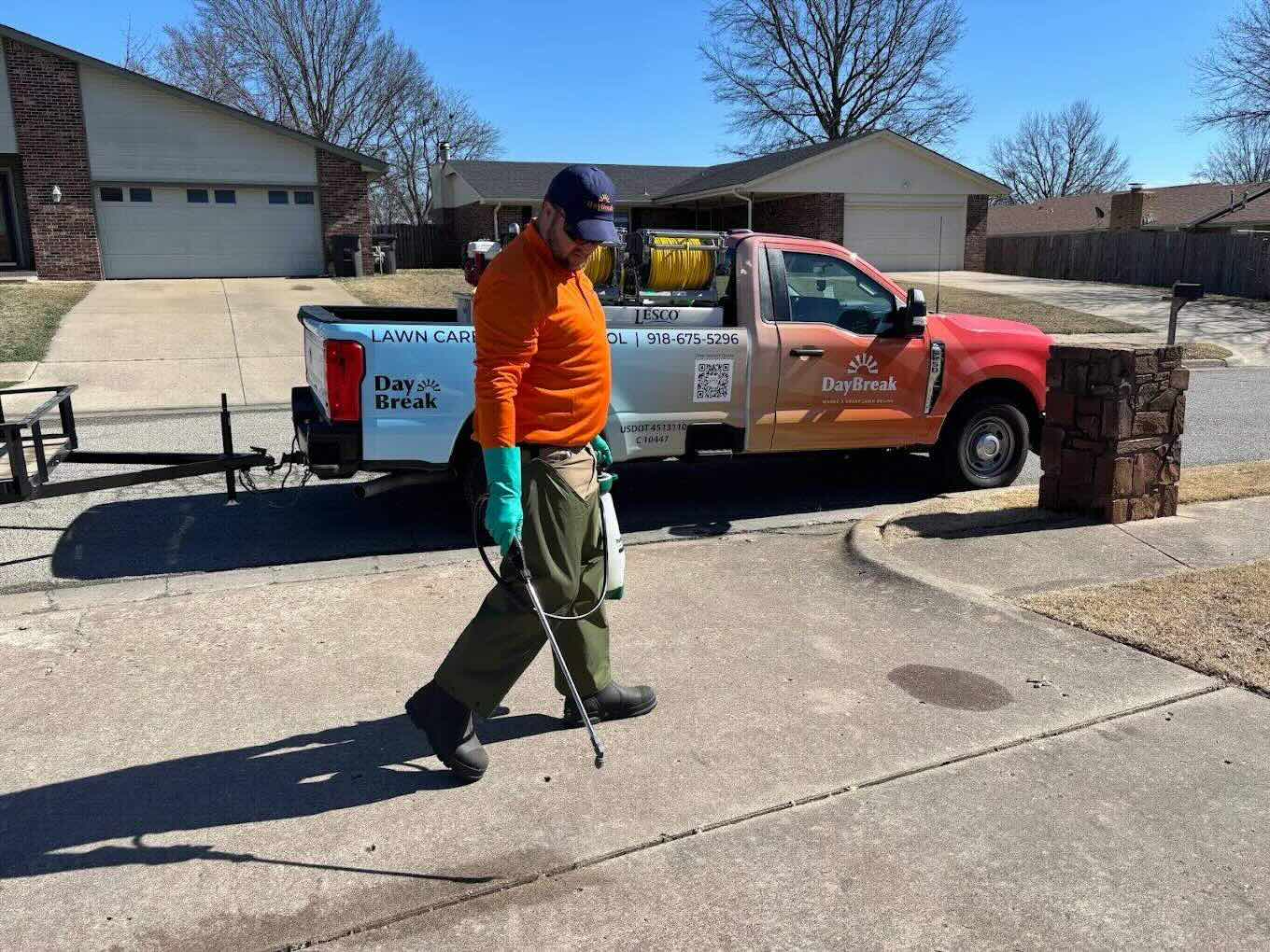
Physical branding — truck wraps, yard signs, uniforms and printed materials — generates ongoing marketing impressions in the neighborhoods where your business already operates. A single branded vehicle wrap reaches an estimated 30,000 to 70,000 impressions per day in typical suburban markets, according to the Outdoor Advertising Association of America's 2024 data — making it one of the lowest-cost-per-impression marketing channels available.
Yard signs placed at job sites with customer permission are among the highest-conversion offline marketing tactics for lawn care companies. A professional sign in front of a well-maintained property is direct proof of your work quality, placed in front of neighbors who share the same lawn care needs. Consistent branding across trucks, uniforms, yard signs and printed materials — the same logo, colors and tagline used on your website and mailers — builds community recognition that makes prospects feel familiar with your company before they ever call.
RealGreen's Print Marketing Services produce forms, inserts, lawn signs, regulatory signs, postcards, flyers and uniforms — customized to your brand specifications. Regulatory sign experts research state and local requirements to ensure pesticide application posting signs meet all compliance standards.
Strategy 11: How Do Online Reviews Affect Lawn Care Business Growth?
Online reviews directly determine whether prospective lawn care customers call your business or a competitor. 97% of consumers check reviews before choosing a local service business, according to BrightLocal's 2024 Local Consumer Review Survey. Your average star rating on Google, Yelp and Facebook is visible in search results before prospects click through to your website.
The most effective review generation strategy is asking every satisfied customer immediately after a successful service visit. Send a follow-up text or email within 24 hours of service completion with a direct link to your Google review page. BrightLocal's 2024 survey found that 77% of consumers are willing to leave a review when asked — the barrier is friction, not reluctance. Respond to every review — positive and negative — within 48 hours. Priority review platforms: Google (highest search impact), Facebook, Yelp, Angi, HomeAdvisor, Better Business Bureau and your local chamber directory. For the full communication playbook behind long-term retention, read our guide on the communication strategies that keep lawn care customers coming back.
Strategy 12: Which Online Directories Should Lawn Care Businesses List On?
Lawn care businesses should maintain accurate, complete listings on eight primary directories: Google Business Profile, Yelp, Bing Places, Facebook, Yellow Pages, Angi, HomeAdvisor and the Better Business Bureau. Consistent Name, Address and Phone number (NAP) data across all listings is required for local SEO — inconsistencies reduce your visibility in Google Maps results.
Angi and HomeAdvisor actively route service requests to listed businesses, generating inbound leads directly. Yelp receives more than 178 million monthly unique visitors (Yelp Investor Relations, 2024). Set a quarterly calendar reminder to audit all listings for accuracy — update seasonal hours, add new services and refresh photos to keep profiles current. Outdated information in one directory can suppress your Google Maps ranking even when other listings are accurate.
Strategy 13: How Do Referral Programs and Service Upsells Grow Lawn Care Revenue?
Customer referral programs incentivize satisfied lawn care clients to recommend your business to neighbors and friends in exchange for a reward — typically a service discount or gift card. Referred leads convert at higher rates, retain longer and require less sales effort than leads from paid advertising.
"We've been able to build on our current customer base with the services we offer. When someone is signed up for two services, why not get them to 15?" — James Manske, Owner, Elkhorn Lawn Care
A well-structured referral program includes a meaningful reward (a free add-on service or a $25 to $50 gift card for every referral that converts), a frictionless sharing mechanism (a unique referral link or promo code) and consistent promotion through email, invoice inserts and post-service conversations. Your best referral sources are your longest-tenured, highest-satisfaction customers. Identify them in your CRM and personally invite them to participate — a direct, personal ask generates significantly more referrals than a general email announcement. RealGreen's Customer Assistant Website includes an optional automated referral program that tracks referral activity directly within Service Assistant. For a closer look at automated upselling, see how ServiceBot drives upsell revenue on autopilot across 25 service categories.
Strategy 14: What Local Partnerships Help Lawn Care Businesses Grow?
Local business partnerships generate referrals from complementary service providers whose customers also need lawn care. The highest-value partnership categories for lawn care businesses are: real estate agents and property managers (who need reliable vendors for listings and managed properties), nurseries and garden centers, home improvement stores and irrigation specialists.
Real estate agents provide high-quality referrals — homeowners preparing to list a property often need immediate lawn improvement, while buyers moving into a new home frequently need ongoing maintenance services. Community sponsorships — a local youth sports team, charity run or neighborhood event — put your logo in front of hundreds of homeowners in your service area with an implied community endorsement, typically at a cost of $200 to $1,000 per event. For more on building your local network, read our Lawn Care Networking 101 guide. RealGreen's partner ecosystem extends your capabilities through integrations with Coalmarch (digital marketing), Waypoint Analytical (soil testing), Applause (employee incentives) and Linxup (real-time fleet tracking).
Strategy 15: How Should Lawn Care Businesses Track Marketing Performance?
Lawn care businesses should track five core marketing metrics monthly: lead conversion rate, customer acquisition cost by channel, email open and click-through rates, Google Business Profile views and calls, and review volume and rating trend. These five metrics provide enough visibility to make confident budget decisions without requiring a dedicated marketing analyst.
"When I first started, we were a little under a million dollars. Now, within those three years, we're a little over 2 million. It's literally doubled in that amount of time just by using what we already had." — Grace DiBenedetto, General Manager, Grassmaster Plus
The most important long-term metric is customer life cycle value — the total revenue a customer generates over their relationship with your business. A customer retained for five years at $80 per month is worth $4,800. Knowing that figure changes how your team evaluates every acquisition channel. Use Google Analytics for website traffic, Google Search Console for SEO visibility, and RealGreen's Service Assistant CRM for lead-to-customer conversion data and campaign reporting. Use the RealGreen ROI Calculator to model the return on routing and operational improvements. For a complete measurement framework, read our deep dive on the KPIs that actually matter for your lawn care business. Schedule a monthly 30-minute marketing review to assess performance and reallocate budget toward top-performing channels.
Not sure RealGreen is the right fit? Compare RealGreen against other lawn care software options to see why thousands of green industry businesses trust our platform.
How Much Should a Lawn Care Business Spend on Marketing?
Lawn care businesses should allocate five to ten percent of gross annual revenue to marketing. A business generating $500,000 in revenue should budget $25,000 to $50,000 per year — approximately $2,000 to $4,000 per month. Newer businesses investing in customer acquisition should budget toward the higher end. Established businesses focused on retention can operate effectively at the lower end.
Budget allocation by function: Foundation (website, Google Business Profile, local SEO, review management) — typically $300 to $600 per month. Acquisition (Google Ads PPC, direct mail, social media ads) — allocate based on measured cost-per-lead performance. Retention and upsell (AMA automation, Customer Assistant Website, referral program) — these scale revenue without proportional cost increases, representing the highest-ROI allocation. Brand building (vehicle wraps, yard signage, print, community sponsorships) — long-term investments that compound in value over multiple seasons. Review RealGreen's pricing and modules to find the right package for your budget and growth goals. For a foundation in margin management, read our guide to landscaping profit margins.
Frequently Asked Questions About Lawn Care Marketing
What is the best free marketing tool for a lawn care business?
Google Business Profile is the best free marketing tool for lawn care businesses. A fully optimized listing places your company in Google Maps results, displays your phone number and hours prominently and shows customer reviews — all at no cost. Claim and verify your listing at business.google.com and complete every field, including service area, photos and business description.
How long does it take for SEO to work for a lawn care company?
Most lawn care businesses see measurable SEO results — higher rankings, more traffic and increased calls from organic search — within three to six months of consistent optimization. Local SEO (Google Maps ranking) typically improves faster than organic ranking, often within four to eight weeks of a complete Google Business Profile optimization.
What is the most effective marketing channel for getting new lawn care customers?
Google Ads (pay-per-click) generates the fastest results for new customer acquisition. Google Business Profile generates the highest volume of free leads for established businesses. Email marketing delivers the highest ROI for customer retention and upsells. The most effective overall strategy combines all three channels with direct mail for new-mover targeting.
How do lawn care companies market in the off-season?
Lawn care companies market effectively in the off-season by promoting winter services (snow removal, holiday lighting, tree care), running prepay incentive campaigns offering discounts for customers who pay next season's fees early and sending year-end renewal reminders. RealGreen's Automated Marketing Assistant triggers renewal and prepay campaigns automatically based on service history.
How do I get more lawn care customers in a competitive market?
To get more lawn care customers in a competitive market: optimize your Google Business Profile with recent photos and reviews, run targeted Google Ads for high-intent keywords, launch a referral program offering $25 to $50 per converted referral and use RealGreen's Direct Mail Services to reach new homeowners before competitors do.
What does lawn care marketing software do?
Lawn care marketing software automates customer communication throughout the service life cycle — sending pre-service notifications, after-service follow-ups, review requests, renewal reminders and seasonal promotions without manual effort. RealGreen's Automated Marketing Assistant and Customer Assistant Website together form a complete marketing automation platform built specifically for green industry businesses.
How much do lawn care businesses spend on Google Ads?
Small lawn care businesses typically spend $500 to $2,000 per month on Google Ads. Mid-market companies with multiple service lines or larger coverage areas spend $2,000 to $8,000 per month. Start with $500 per month, measure cost per lead and scale spend on keywords that convert.
What is the ROI of email marketing for lawn care businesses?
Email marketing delivers $36 to $40 in return for every $1 spent in the lawn care industry, according to Litmus's 2024 Email Marketing ROI Report — the highest ROI of any marketing channel. Automated email sequences set up once through RealGreen's AMA run continuously without additional time investment from your team.
"RealGreen is absolutely worth its weight in gold. I can't imagine life or running a business, without it. It makes my job a whole lot easier." — Bob Brower, General Manager, Lawn Plus
Ready to grow your lawn care business with integrated marketing, automation and field management software? Schedule a free RealGreen demo today and see how our platform helps you manage more customers, generate more referrals and close more sales — without adding more personnel.


.jpeg)