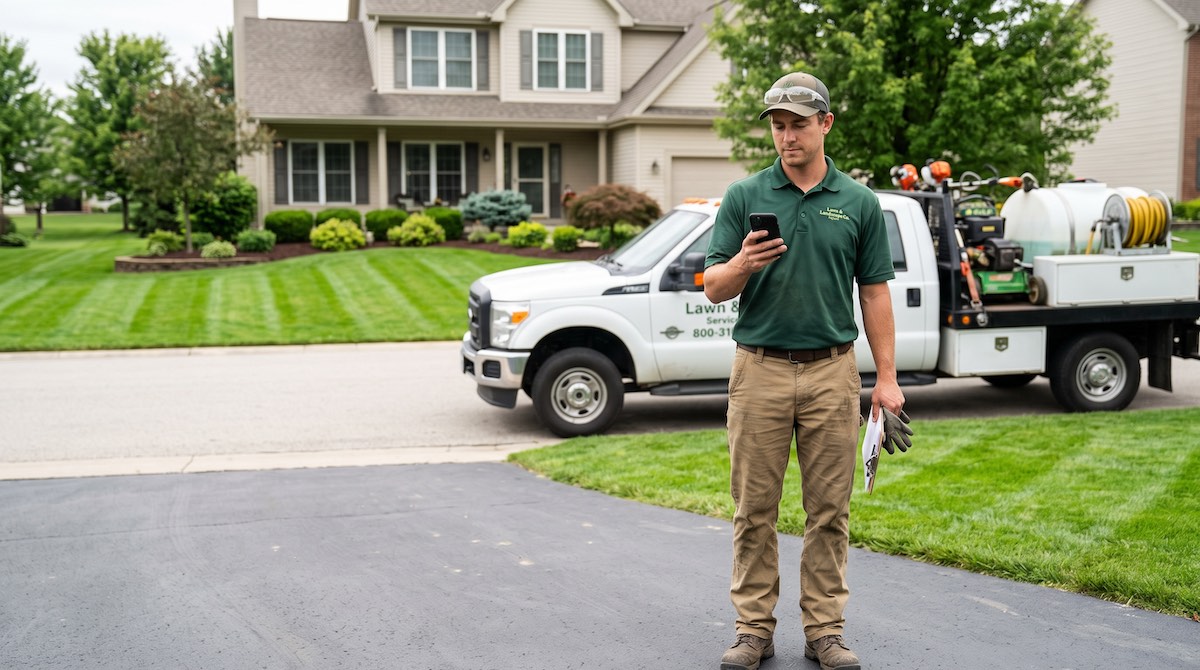
The most effective way to upsell lawn care services is to let your technicians do it on the routes they already run. When techs keep accurate customer notes, understand the difference between a helpful recommendation and a sales pitch and have AI tools that identify problems on the spot, routine visits turn into add-on revenue with little or no extra labor time.
Every day, your technicians walk more properties than your sales team could visit in a month. They see the grub damage starting along the fence line, the weeds creeping into the front bed and the thinning turf under the oak tree that is going to look a lot worse by July. They are standing in the exact spot where a customer's next problem is taking shape.
Yet in many lawn care companies, very little of that knowledge turns into new business. The tech finishes the application and moves on to the next stop.
That is not a people problem. Most technicians did not sign up to be salespeople, and many are uncomfortable with the idea. It is a systems problem. When techs have the right information, a clear understanding of what a good recommendation looks like and tools that make it easy, upselling stops feeling like selling. It starts feeling like doing the job well.
Why Accurate Customer Notes Are the Foundation of Every Upsell
A great recommendation depends on context, and context lives in your customer notes. Did this customer turn down aeration last fall because of cost, or because they were traveling? Do they have a dog that affects which products you can use? Did a previous tech flag a drainage issue in the backyard?
When those notes are thorough and accurate, a technician can walk onto a property already knowing what matters to that customer. When they are thin, inconsistent or missing, every visit starts from zero, and recommendations come off as generic at best and tone-deaf at worst. Keeping that history in one lawn care CRM means every tech sees the same complete picture.
However, thorough notes take time, and time is the one thing techs never have enough of. Typing on a phone screen with gloves on, in the rain, between stops, is nobody's idea of efficient. That is why so many notes end up reading: "service completed."
The right mobile technology can improve this significantly with voice-driven AI tools that let technicians dictate notes as they work, without stopping to type or navigate menus. The result is easier, better notes, because capturing that detail no longer competes with getting to the next stop.
What Is an Upsell in Lawn Care, and What Is It Not?
Many technicians resist upselling because they do not want to be thought of as pushy. That is worth addressing head-on in training.
A real upsell is a recommendation that solves a problem the customer has or is about to have. In each case, the tech is doing what customers already expect from a professional: noticing what they cannot and telling them about it. Examples of real upsells include:
- Pointing out early signs of disease and suggesting a fungicide treatment
- Recommending core aeration for compacted soil
- Suggesting grub control when you see the first signs of damage
These are not upsells:
- Pushing a service the property does not need just to hit a sales number
- Recommending the same add-on to every customer regardless of conditions
- Leaving a generic flyer instead of explaining what you actually saw
These tactics may get you an occasional sale, but they are far more likely to cost you customers and valuable long-term relationships.
When techs understand the difference, the conversation changes. They are advising rather than selling, and customers can tell the difference.
It also helps to give technicians simple language to use. Something as straightforward as "I noticed this today, here is what it is and here is what we can do about it" goes a long way, especially for newer crew members who are not sure how to start the conversation.
Which Lawn Care Services Are Easiest to Upsell Without Adding Labor Time?
The best upsells for technicians are services tied to a condition they can see during a normal visit and that can be completed on an existing route stop or bundled into a seasonal visit. These services fit naturally into a field recommendation because the tech is already on the property and can show the customer the problem:
- Grub control, when a tech spots early turf damage or animal digging
- Fungicide treatments, when early signs of lawn disease appear
- Core aeration and overseeding, bundled into a fall or spring visit for compacted or thinning turf
- Spot weed control in beds, driveways and walkway cracks
- Mosquito and tick perimeter treatments for customers who use their yards heavily
- Lime or soil amendments when soil conditions are holding the lawn back
For a broader view of what to offer, see our full lawn care services list. If you are adding pest add-ons, our guide on how to sell mosquito control services covers positioning in more detail.
How AI Helps Newer Technicians Make Confident Recommendations
For most companies, your best upsellers are your most experienced techs. They have seen every weed, every disease and every pest. They can identify a problem from across the yard and explain it in a way that makes sense to a homeowner.
Your newest hires cannot do that yet. And in an industry with high turnover and seasonal hiring, at least part of your crew will always be newer.
AI is starting to close that gap. Tools that can instantly analyze a photo of an unfamiliar weed, a patch of damaged turf or a pest infestation give newer technicians a reliable way to identify what they are looking at and understand how to treat it. Instead of guessing, or calling the office and waiting, they can get an answer while they are still at the property.
The same goes for job history and customer preferences. When a tech can simply ask for a summary of a property's past treatments and notes, they walk into every stop with the background knowledge and confidence that used to take years to build. We have written more about how AI and automation help lawn care companies scale.
Summaries do not replace training or experience. But they do mean a technician in their first season can make confident, accurate recommendations instead of only doing the bare minimum.
How to Build the Infrastructure Behind Technician Upsells
Even the best recommendation goes nowhere if nothing happens after the tech mentions it. This is where many companies leave money on the table. A strong upsell program follows a consistent process:
- Techs log what they observed and recommended, ideally with a photo, before leaving the property.
- Recommendations flow back to the office or into follow-up campaigns automatically, rather than relying on someone to remember to share them.
- Customers receive a clear, specific quote through automated customer communications such as text or email.
- Managers see which techs are identifying opportunities, which recommendations convert and where coaching would help.
Having this infrastructure in place brings consistency. When every technician has access to the same information and the same tools, service quality stops depending on who happens to be on the route that day or who has been with the company for ten years. Customers get the same expert eye on every visit, and your business gets a steady stream of revenue opportunities from work your crews are already doing.
Why Time Is the Real Differentiator
There is one more crucial piece of the upsell puzzle. Techs cannot spot opportunities or have meaningful conversations with customers if too much of their day is consumed by admin work. Navigating apps, hunting for gate codes, logging applications and closing out jobs all take time, and that time adds up.
When a mobile app built for lawn care technicians takes that busywork off their plates, techs get time back. Some of that time goes to additional stops. Some goes to slowing down long enough to really look at a property and talk with the customer. Both are good for business.
Your technicians are already your most valuable source of growth. They are on the properties, they see the problems and they have the trust of your customers. What they need is accurate information, a clear understanding of what helpful recommendations look like, tools that put expert knowledge at their fingertips and a system that turns their observations into action.
Get those pieces right, and upselling stops being something you push your crews to do. It becomes a natural part of how they serve customers every day.
Frequently Asked Questions
How do lawn care technicians upsell without being pushy?
Technicians avoid sounding pushy by only recommending services tied to something they actually saw on the property. Explaining the problem, showing a photo and offering a specific fix positions the tech as an advisor. A simple script such as "I noticed this today, here is what it is and here is what we can do about it" keeps the conversation helpful.
What lawn care services should I offer to upsell without adding much labor time?
The easiest upsells are services your crews can complete on an existing route stop or bundle into a seasonal visit. Grub control, fungicide treatments, spot weed control, aeration with overseeding and mosquito perimeter treatments all fit this model because technicians can spot the need during a routine visit and the work uses equipment already on the truck.
How can AI help lawn care technicians identify upsell opportunities?
AI tools can analyze a photo of a weed, turf disease or pest problem and tell a technician what it is and how to treat it while they are still at the property. AI can also summarize a customer's treatment history and notes, so even first-season techs can make accurate, confident recommendations.
How do I track upsells from field technicians?
Give techs a consistent way to log observations and recommendations in your software, then route those recommendations to the office or into automated follow-up campaigns. Reporting should show which techs identify opportunities and which recommendations convert, so managers know where to coach and which services sell best in the field.
How can lawn care software help me grow recurring revenue?
Lawn care software grows recurring revenue by capturing complete customer notes, making it easy for technicians to log recommendations in the field and automatically following up with customers by text or email. When every observation becomes a tracked opportunity, more one-time add-ons convert into ongoing programs and fewer recommendations are lost between the field and the office.